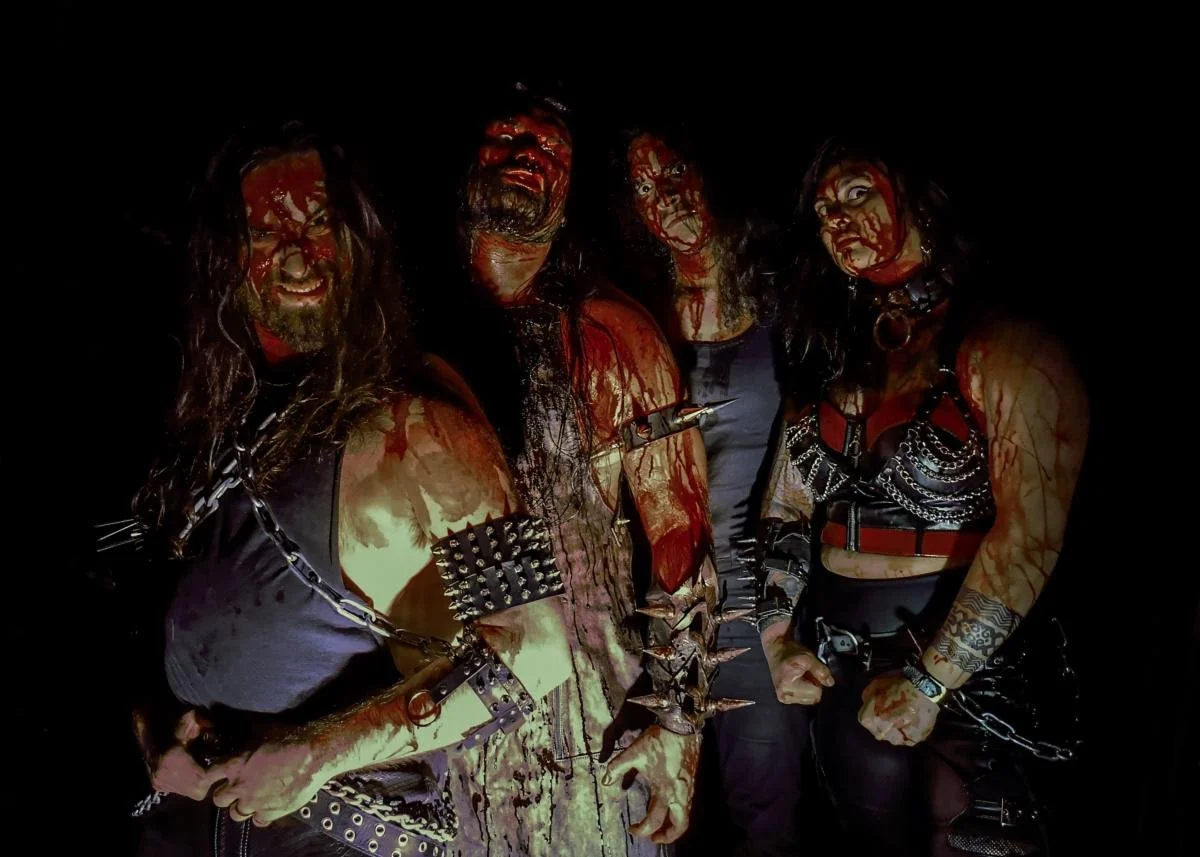
Interview: Cartilage Talk Creation Of New Concept Album "Operating Altar"
Somewhere in the depths of St. Petersen’s University Hospital, a sick individual lurks in squalor. He performs some of the most vile, depraved experiments and surgeries on patients that he comes across. His madness knows no end. This surgeon is a character straight out of a nightmare that San Francisco-based metal act Cartilage’s lead vocalist Mark Wallace had. The dream left him and his bandmates so transfixed that they decided the material was ripe enough to construct an album around.
Enter Operating Altar, the next album from Cartilage, a brutal escapade into the mind of a sick and twisted surgeon living on the outskirts of society. Over ten tracks, the death/grind metal collective brings the stories to life with plenty of riffs, blast beats, guttural vocals, and lots of bloody imagery. Ahead of the release, Shameless SF sat down with guitarist Michael “Mike” Flory and vocalist/guitarist Teresa “Ria” Flory to talk about what goes into making a concept record as a death metal act, how the story came about, and what listeners can expect when the album is available everywhere tomorrow.
Main Photo: Kei Mowry
Where did you come up with the concept for this album about a “mad surgeon hell-bent on continuing decades of misdeeds at his venue of choice: St Petersen’s University Hospital”?
Michael Flory: The concept of the record basically came from Marky [Mark Wallace], our vocalist. He had a nightmare about getting surgery done to him while he was conscious. In the dream, the surgeon rearranged his organs into a magical sigil. We basically thought that was a really cool idea for a concept record. We had talked about doing a concept record for the past two or three years, just because we all love King Diamond. We listen to a lot of King Diamond on tour. We thought it would be really fun experiment to try, especially because the band is so rooted in heavy metal and cheesy horror movies. That was a way to combine both.
It started with that. Then Marky and I started to pave out a bit of a storyline, beat by beat, after he was telling us about the dream. Then we structured the story from there, and wrote the music accordingly.
I wondered if there were any kind of B-horror movies that played into that inspiration as well, giving it that grindhouse feel. When you’re putting together these songs, with metal, you’re starting with a riff or a drumbeat and then piecing it together from there. In this case, would you say that the story took more precedence at first, before you started compiling the songs together? Or was it all happening at once?
Teresa Flory: I think it was all happening together simultaneously. We were working in the jam space for awhile on some riffs. Progressively through that, we’d be working together at home on some storyline stuff. It was pretty synergistic.
Michael: Yeah, I would say it started that way, but then we ran into some issues with the writing process. We ended up writing out the entire story and then finishing the record. I would say that we had a handful of songs that we were working on, jamming them in the room. I think we had a hard time mostly with everyone’s schedule and how much planning had to be done to pull off the conceptual part of it.
Teresa: Yeah, last year in general was just a very busy year. We toured twice, I toured twice in Europe with my other band [Emasculator], so it was a lot to try and work out. Eventually through the writing process, we knew that we needed to write motifs and callbacks, and arranging that is a whole other beast.
Was there any song on this album that was maybe more difficult than the others to come together?
Michael: I’m trying to think, there was kind of a lot, honestly. (laughs)
Teresa: (laughs) It was all such a blur!
Michael: The two songs that I think were the trickiest to sort of balance creatively with the story were “Lymphatic Labyrinth of Roiling Rot”, which is the song that’s straight in the middle and acts as the transitional song between the A-side and B-side of the record, where the story kinda shifts gears narratively, and the last song, “Stitch By Stitch”. There are a lot of ideas in those songs that are disparate from each other, and it was just trying to quite literally, no pun intended, stitch together everything in a narrative sense. For me, that was what I was trying to do musically. I wrote predominantly most of the music on this record, but Ria [Teresa] wrote the lyrics for the record. I think we had an interesting dialogue towards the end of the writing and tracking process, trying to balance it. Those are the two things that we had to work pretty hard on together to make sense of.
When you’re at a point where you’re stuck and trying to figure out what to do, how do you navigate the difficult areas? What kind of problems arise in that sense, musically and lyrically? Would a line not work? Would a blast beat end up being too fast?
Michael: That’s never the case. It’s not fast enough! (laughs) I would say that the lines are what we struggled with the most. We had the story beats figured out for the most part. Like Ria said, we had ideas going in when we wrote the storyline, but after we got over our initial difficulties, it would be a process of “storyline, music, lyrics”, if I was to simplify it. [The problem] we ran into a little bit in the final stage was after writing the music and motifs, trying to get the lines to make sense narratively in context with them all together in the record. We would go, “Oh wait, we didn’t explain that one thing in the previous song, so this doesn’t really make sense.” So we’d have to go back and switch stuff around.
We would also nudge things to convey moods, like knowing that there’s a riff that would have to inhabit the main character’s current emotional state and trying to make sure the lyrics reflect that.
Teresa: We talked about this repeatedly, even before doing the lyrics, that we didn’t necessarily want to do something where the [lyrics] are like, “Oh, I’m running down the hallway! As I’m running, etc.” We were like, “we can’t fucking do that”. (laughs)
Michael: Yeah, we had to make it interesting at least.
You’ve pushed yourself beyond your limits with Operating Altar, and you’re playing at tempos that you haven’t pushed for on previous albums. How much time does it take for the band to come together and lock in when playing at these faster speeds?
Teresa: Yeah, we live together so when we need to get together and work on the parts and make sure they’re super solid and that the harmonies are on point, we jam together at home and then we bring it together with Adam [Houmam, drummer]. The other day, we were jamming through the songs and going “does this sound sicker pushed a little bit more? Should we slow this part down?” We’re just trying to work it out in the room together.
These parts are pretty extreme, but now that we’ve been playing them a good amount together since we’re getting ready for tour, we’ll be like, “Oh, this riff was so hard to record, and now it’s like so much easier to play!”
Your muscles are warmed up to it now.
Teresa: Yeah, you’re like, “I wish I was able to play it this fluidly when we were recording!”
Michael: I think it helps that we were all in brutal death metal style bands before we started this one. This is now our main project. I think we had that riff style and those levels of tempos in our DNA anyway. It is tough because you have to get your chops back a little bit, to play that style. But after awhile, when you’re just hammering it out, it’s not as bad. It’s in there somewhere. And Ria plays in an awesome brutal death band now as well, so she’s got the chops. I’ve been a little rusty on my end.
The song titles are not exactly subtle, nor is really anything with death metal and grind metal. Are there any lyrics on this album that you found to be particularly brutal?
Teresa: I mean, nothing shocks me because we watch so many horror movies and stuff. We’re in a D&D campaign together, so for a couple of years, coming up with stories and all these combined useful skills, I just pulled from the deepest roleplaying skills I have and horror movie watches. There was nothing that was really too brutal [lyrically]. I listen to a lot of hip-hop, so when I write lyrics, there’s usually too many syllables and trying to make that realistic in performing it and actually recording it. To me, that was actually the most brutal part.
Michael: For me, the lyrics that come across as the most brutal are maybe on “Among The Awful”. Those are the only lyrics that Ria, Marky, and I had no hand in. You were just handed a complete idea, and there was no preconceived notion of it. In my mind, those are the most brutal, but probably because I had the opportunity to be shocked. I was around when Ria wrote most of the lyrics, and then I wrote a handful, and then Marky wrote a handful, so those were less surprising to me. That’s the first one that came to my mind, because Adam handed us complete lyrics, and it was kind of a treat to read through and go “Whoa, this dude’s disgusting. This is a sick-minded individual.” (laughs)
Cartilage’s new album, Operating Altar, will be available on September 11th, 2026 via Everlasting Spew Records. The band is gearing up to kick off their on September 15th in San Diego, CA, and a Bay Area date will be taking place at San Francisco’s Mabuhay Gardens on September 19th.

